How intelligent systems work across tools, machines, and repositories.
ForgeWire Labs studies how model-assisted software can preserve useful context and human direction, how distributed execution makes authority clear, and how repositories retain durable, reviewable state. Public project materials show these questions in practice across released software, previews, and private development.
Current investigations
Questions shaping the work
From model-assisted workflows to distributed execution and repository state, these investigations guide current engineering work.
ForgeWire · private development
How can a person keep useful context and decision authority when software coordinates models and tools?
ForgeWire explores an application and runtime built around project context, selected tools, focused workflows, and outcomes a person can review. Its public overview describes this private-development direction.
What should be explicit when work is placed across machines?
Fabric explores an authenticated, policy-gated execution control plane. Its public overview describes a configuration-dependent connection for selected ForgeWire workflows.
What should a repository retain so later work can be inspected?
RepoPact Core provides a public implementation example for repository-owned records, validation, and typed operations. Its evidence is specific to RepoPact and its released CLI package.
Rust defines the semantics; the CLI exposes supported operations.
Core reads repository records, validates them, and prepares typed operations through a canonical Rust engine. Its stable published package is version-scoped; the source tree can continue to evolve separately.
Anvil stores planning records in a single-writer JSON file and links typed references to external work. Its API and schema can change; its documented scope excludes execution ownership and audit trails.
A published application and a beta platform have separate maturity.
The released Windows app supports certification study. Newer course-platform development and its import/export behavior remain in beta and are not folded into the app's release claim.
The public repository is a governed test project used to exercise RepoPact behavior under routine and adversarial cases. Its current setup pins RepoPact 3.0.2, so it does not establish validation coverage for the newer 3.1.3 Core package. The proving ground is evidence and test material, not a separate flagship or commercial product.
RepoPact records stay authoritative in RepoPact's documented model.
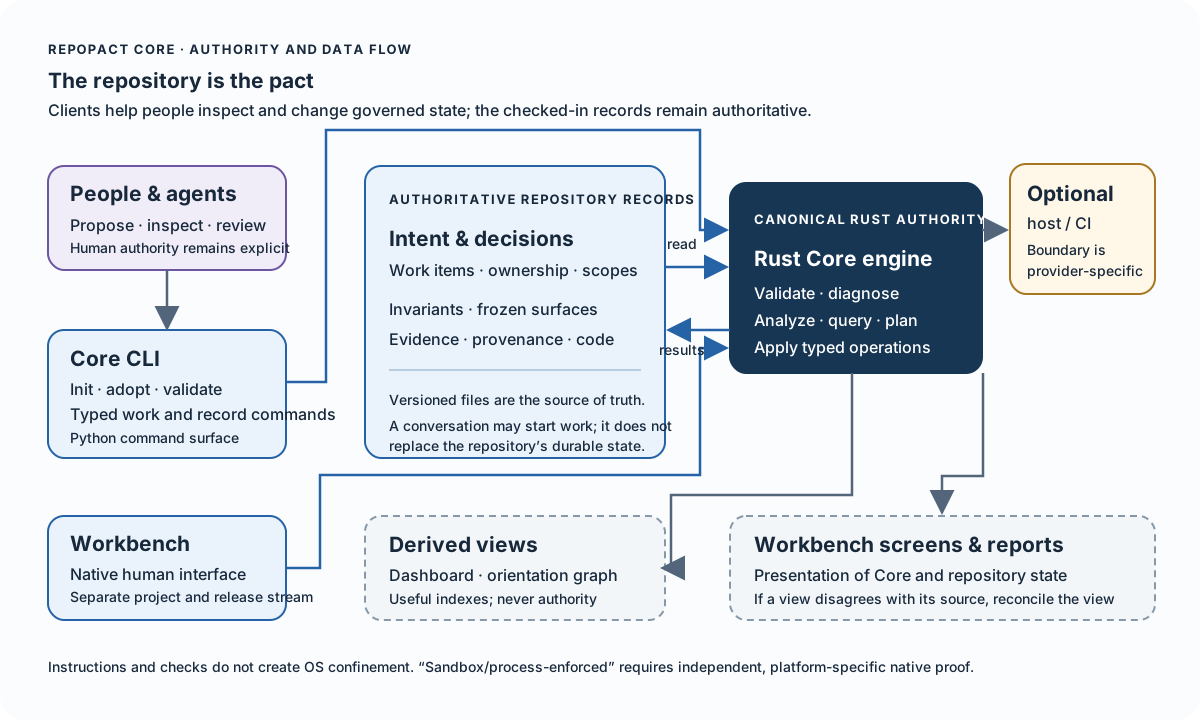
The CLI and Workbench read governed records and request supported operations from Core. The engine validates records and prepares plans. Dashboards and graph views are derived surfaces, while evidence records observed results.
This diagram documents RepoPact Core. It does not describe ForgeWire, Fabric, Anvil, Flink, or a shared ForgeWire Labs platform.
Diagram key. Blue arrows mark exchanges with Core. Slate arrows mark human or host interactions, evidence, and derived-view relationships. Dashed boxes are derived views; the host/CI integration is optional and provider-specific.
Evidence boundary
Read the source that owns each claim.
A public README, a source build, a package, a platform check, and a private overview show different kinds of evidence. Release notes and project sources define the exact behavior visitors can inspect.